
A sweeping mid-decade redistricting proposal Gov. Ron DeSantis unveiled this week would significantly reshape the Sunshine State’s congressional map, placing two high-profile Democratic incumbents on unsteady political terrain while consolidating Democratic voters into fewer districts.
The plan markedly targets South Florida, the state’s most heavily Democratic region, where five of nine congressional seats spanning Districts 20 through 28 are, or were most recently, held by Democrats.
Most glaringly, DeSantis’ map would slash Democratic advantages in Florida’s 23rd and 25th Congressional Districts, represented, respectively, by U.S. Reps. Jared Moskowitz and Debbie Wasserman Schultz.
It would also leave some areas in the region largely intact. Districts 27 and 28, represented by Republicans María Elvira Salazar and Carlos Giménez, respectively, would see minimal changes.
A small adjustment would also shift part of northeastern District 20 into the southern portion of District 21.
Elsewhere, the changes are substantial.
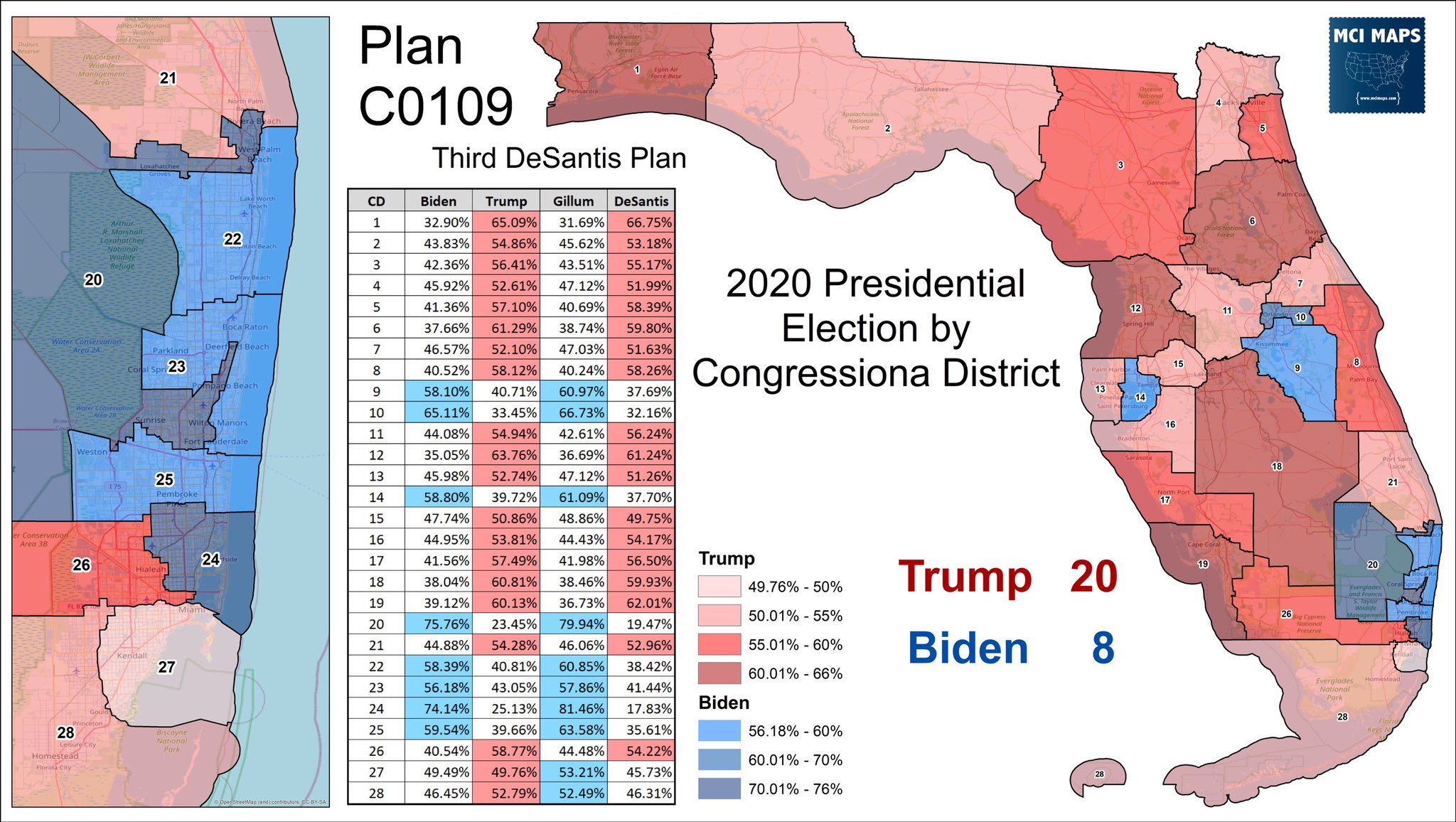
One of the most notable shifts affects Democratic U.S. Rep. Lois Frankel. Under the proposal, her home would be moved out of the current Palm Beach County-based District 22 and into a reconfigured District 23.
That district would be dramatically redrawn, shedding its Broward County base — a reliable source of Democratic votes — and instead taking in much of Frankel’s current territory, along with a smaller inland extension and a slight overlap with current District 20.
Even so, the new District 23 would still lean Democratic. A Dave’s Redistricting analysis shows 56% of voters there backed Democrat Kamala Harris in the 2024 presidential election.
Moskowitz, by contrast, would face a more challenging landscape. He would be drawn into a newly configured District 22 that stretches inland from the coast and spans parts of Palm Beach and Broward counties while extending deep into Hendry and Collier counties — areas that trend more Republican.
In that newly drawn district, 54.6% of voters supported President Donald Trump in 2024.
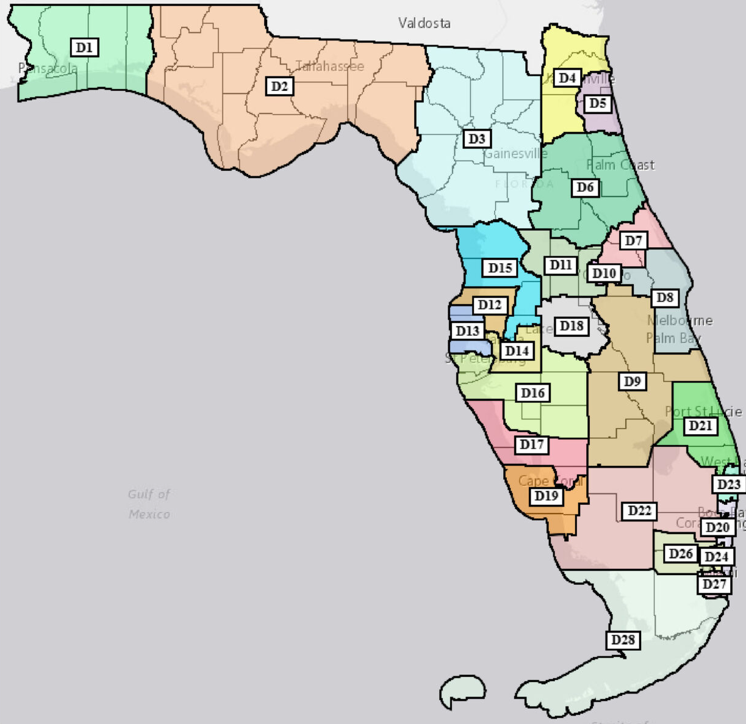
Wasserman Schultz would also be displaced from her current Broward County stronghold. The proposed District 25 would shift into a coastal seat running from Delray Beach through Broward County and into Miami-Dade’s barrier island communities, including Miami Beach and Sunny Isles Beach.
She, like Moskowitz, would instead be pushed toward the reconfigured District 22, forcing both lawmakers to weigh difficult decisions about where to run.
Other Democratic incumbents appear less directly affected. U.S. Rep. Frederica Wilson’s District 24 would lose its coastal portion, but retain many of its Democratic-leaning municipalities, including Miami Gardens, Miramar and North Miami.
She would remain in a district that still heavily favors Democrats, with nearly 69% of voters there siding with Harris in 2024.
The plan is part of a larger national redistricting push encouraged by Trump, who has urged Republican-led states to redraw maps to help maintain GOP control of Congress.
Florida lawmakers are expected to take up the proposal during a Special Session.
Critics argue the map may violate Florida’s Fair Districts Amendment, which passed with 62% support in 2010. It requires, among other things, that Florida’s maps be drawn without favoring a political party or incumbent and to protect minority voting rights.
Supporters within the Governor’s Office contend those provisions may not be enforceable, citing ongoing legal challenges. In 2015, the Florida Supreme Court ruled that two South Florida congressional districts had been drawn to favor a political party, violating the Fair Districts Amendment.
The court ordered the map redrawn, forcing changes that reshaped several districts ahead of the 2016 elections.
The post Gov. DeSantis redraw targets Jared Moskowitz, Debbie Wasserman Schultz appeared first on Florida Politics – Campaigns & Elections. Lobbying & Government..