
Gov. Ron DeSantis has signed the “Officer Jason Raynor Act,” capping a three-year push by the families and colleagues of a lawman killed in the line of duty to ensure the outcome of his assailant’s case can never be repeated in a Florida courtroom.
The measure (SB 156), sponsored by St. Augustine Republican Sen. Tom Leek and Jacksonville Republican Rep. Jessica Baker, is named for 26-year-old Daytona Beach police officer Jason Raynor, who was fatally shot during a lawful detention on Aug. 17, 2021.
Prosecutors sought a first-degree murder conviction of Raynor’s killer, Othal Wallace, who resisted detainment and shot Raynor in the head. Jurors found Wallace guilty of a lesser manslaughter charge, resulting in a 30-year sentence — due, in part, to the State Attorney’s failure to include a firearm enhancement on the verdict form.
That oversight was not the focus of the bill’s proponents, who stressed that in police detention situations, detainees should be submissive and wait to argue the merits of their potential arrest before a Judge.
DeSantis reiterated that argument ahead of the bill’s signing in Winter Haven, where he was joined by Attorney General James Uthmeier, several law enforcement officials, a trio of Representatives and Peggy Raynor, mother of the bill’s namesake
“Disagreements about an arrest should be settled in a courtroom, not through violence on the street,” said the Governor, who signed four other measures Tuesday.
“The message we send with this bill is simple: if you attack a law enforcement officer in the state of Florida, prepare to be held accountable.”
The new law, which became effective upon receiving the Governor’s signature, generally requires life in prison without parole for anyone convicted of killing a law enforcement officer.
It also expands who qualifies as a protected officer to include correctional, probation and auxiliary officers; raises offense severity for assault, battery, aggravated assault and aggravated battery when the victim is an officer; and eliminates certain defenses for resisting officers acting in good faith.
The bill defines “acting in good faith” as making sincere and reasonable efforts to comply with legal requirements, even if the arrest or detention is later found to have been unlawful — language Leek added last year in response to concerns from Black Caucus members.
The Senate passed SB 156 on a 31-4 vote in January, while the House approved the measure 103-8 in March, with several Democrats arguing the measure is superfluous or too broad.
Tampa Rep. Dianne Hart-Lowman said that while she supported police and her “heart bleeds for” Raynor’s family, the legislation is unnecessary because it mandates a punishment the prosecutor in Wallace’s case could have sought, but didn’t.
Aaron Wayt, President-elect of the Florida Association of Criminal Defense Lawyers, highlighted the oversight during the committee process, noting that Wallace received a lighter sentence because the State Attorney in the case, R.J. Larizza, had failed to properly fill out the verdict form with a firearm enhancement for the manslaughter charge.
Had he done so, Wayt said, Wallace could have received the same sentence SB 156 would now require.
“We should not rewrite sentencing laws and take discretion away from Judges because of one prosecutor’s missed opportunity,” Hart-Lowman said. She argued that, like another bill that passed this year, Missy’s Law, SB 156 is “an example of responding to a case-specific failure by imposing a broad rule on all future cases.”
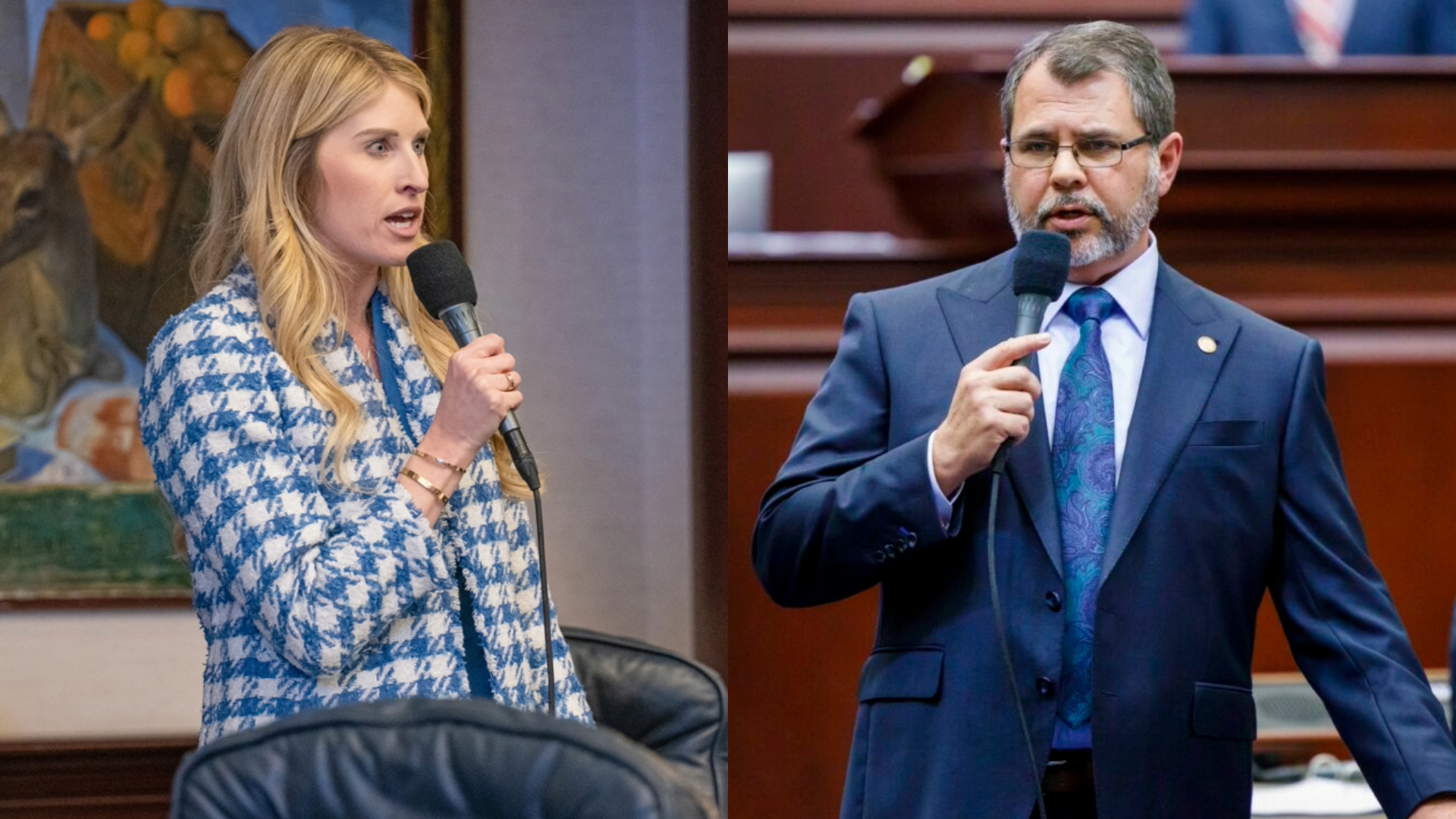
Other lawmakers described the legislation as a loophole-closer that provides closure to the aggrieved.
Port Orange Republican Rep. Chase Tramont, who spoke of how he joined many other pastors in visiting and praying for Raynor at the hospital after the shooting, said the event’s aftermath was emotionally taxing on the community.
“This bill brings a little bit of justice to that family,” he said.
Other criminal justice measures approved
DeSantis also signed four additional criminal justice measures Tuesday.
SB 432 — sponsored by Jacksonville Republican Sen. Clay Yarborough and Republican Reps. Rachel Plakon of Lake Mary and Doug Bankson of Apopka — codifies “Meg’s Law,” named for Meg Caldwell, a Florida woman who died following a struggle with nitrous oxide addiction.
That provision bars licensed tobacco and nicotine dealers from possessing, selling or giving away nitrous oxide, known commonly as “laughing gas” or “whip-its.”
SB 432, which mostly goes into effect Oct. 1, also targets trafficking in xylazine, a veterinary sedative increasingly mixed with fentanyl and other illicit drugs and known on the street as “tranq.”
The measure creates a first-degree felony for trafficking in xylazine, defined as possessing or bringing 28 grams or more into the state, with a mandatory minimum three-year prison sentence for those who sell, manufacture or deliver it.
“We’ve led the nation in taking decisive action against emerging drug threats, and we’re continuing to do that with this bill today,” he said.
SB 1332, sponsored by Fort Myers Republican Sen. Jonathan Martin and Baker, is intended to strengthen Florida’s Career Offender Registration Act by requiring repeat criminals to register in person at their local Sheriff’s Office within 48 hours of release or establishing a residence, and to update their registration annually.
The measure, effective Oct. 1, also expands the information repeat offenders must provide to include employment, vehicles, phone numbers, professional licenses and immigration status. Their driver’s licenses or identification cards must also carry a “775.261” notation corresponding to the updated statute.
Local police agencies must verify offender addresses at least annually and report any compliance failures to the Florida Department of Law Enforcement.
HB 429, sponsored by Baker and Belleview Republican Rep. Ryan Chamberlin, is meant to update Florida’s criteria for establishing gang membership in the digital age.
Under the measure, effective July 1, online admissions of gang affiliation, gang-related social media activity and identification by criminal gang organizations themselves can now count among the criteria — two of which must be satisfied — for a person to be classified as a criminal gang member subject to enhanced penalties.
DeSantis connected the bill to another law (HB 1471) he signed this year enabling Florida’s Governor and Cabinet to designate organizations as terrorist groups.
“You have some of these, like, the Muslim Brotherhood, the Council of American Islamic Relations, like that, no doubt, right?
“You have some of these, like the Muslim Brotherhood, the Council of American Islamic Relations (CAIR), like that, no doubt, right? But you also have, like, Tren de Aragua, that should be categorized as a designated,” he said. “We will be doing that.”
The United States government has not designated the broader, international Muslim Brotherhood as a Foreign Terrorist Organization, it has officially designated specific chapters and branches as such.
CAIR has not been designated a terrorist organization by the federal government, though its status has been the subject of significant legal and political debate.
DeSantis also signed SB 436, sponsored by Leek and Astor Republican Rep. Richard Gentry, which expands the list of prior convictions that can elevate a subsequent battery charge to a felony.
The measure, effective July 1, adds a prior conviction for resisting an officer with violence to the qualifying offenses that allow a second battery to be prosecuted as a third-degree felony, punishable by up to five years in prison, five years of probation and $5,000 in fines.
“So now,” DeSantis said, “those individuals will be held accountable in a more significant way.”
The post ‘Prepare to be held accountable’: Gov. DeSantis signs Officer Jason Raynor Act, 4 other criminal justice bills appeared first on Florida Politics – Campaigns & Elections. Lobbying & Government..