
Three years after Florida enacted sweeping restrictions on public-sector unions, AFSCME Florida continues to post lopsided recertification victories across the state, with workers in Jacksonville, Polk County, Miami Gardens, DeFuniak Springs and Naples all voting overwhelmingly in recent weeks to retain union representation.
The results show that one of Florida’s largest public-sector unions has adapted to — and, by its own account, overcome — the challenges posed by a 2023 law championed by Gov. Ron DeSantis that imposed new membership and recertification requirements on many government-worker unions.
AFSCME Florida reported in December that it won 30 of 32 recertification elections in 2025. Some of the wins included bargaining units that lost certification during the turbulent early implementation of the 2023 law, but rebuilt membership and won recognition back.
The latest success came this week, when Jacksonville city employees represented by AFSCME Local 1279 voted more than 98% in favor of recertification.
“Day by day, week by week, the members of AFSCME Local 1279 continue to build a stronger union, and it shows,” AFSCME Florida Administrator James Spears Jr. said.
“A growing membership is helping to amplify the voice of working families across the region. And their commitment to the citizens they serve is an example of why public service matters. We are excited that this overwhelming victory will allow this great progress to continue.”
The law in question (SB 256), sponsored by then-Spring Hill Republican Sen. Blaise Ingoglia — whom DeSantis appointed CFO last year — hiked membership requirements for most public-sector unions from 50% of a bargaining unit to 60%. It also blocked collective bargaining organizations from automatically deducting dues from members’ paychecks.
By May 2025, more than 100 unions in Florida had been decertified, with roughly 69,000 Florida workers losing representation, according to an Orlando Weekly analysis. Through this past March, there were 209 decertification votes in the state targeting teacher unions alone, though none came close to succeeding, CBS News reported.
Arthur Finley, President of AFSCME Local 1279, described SB 256 as a “massively disruptive piece of legislation” that gave unions little time to adjust to its changes and initially led to the organization’s decertification in February 2024.
In September, after re-registering hundreds of members, implementing a new dues payment system and holding dozens of meetings on the matter, Local 1279 ratified a new contract with Jacksonville by a 99% vote.
“We lost our union at the start, but working with the council and other AFSCME locals in the area, we were able to get on track and win it back,” Finley said. “Plenty of members knew we had to keep fighting, and that gave us the resources to make this new contract happen.”
The union’s win this week capped a busy stretch of successes across the state in 2026. This month, local AFSCME chapters scored recertification triumphs in DeFuniak Springs, Hialeah, Miami Gardens, Naples and Polk County. Preceding recertification wins took place this year in Hallandale Beach, Miami–Dade County, Miami-Dade’s Jackson Health System and Orange County.
In 2025, AFSCME saw recertifications in several of those localities and in Avon Park, Bay Harbor Islands, Dania Beach, Daytona Beach, Manatee County, Martin County, North Port, Oakland Park, Opa-locka, Pinellas Park, Surfside, the University of Central Florida, Venice and Willison.
Similarly successful votes occurred in 2024.
The margins of those wins, which mostly exceeded 90% votes, are encouraging for AFSCME and other unions in the face of legislation going into effect next week designed to make it even harder for public-sector employees to organize.
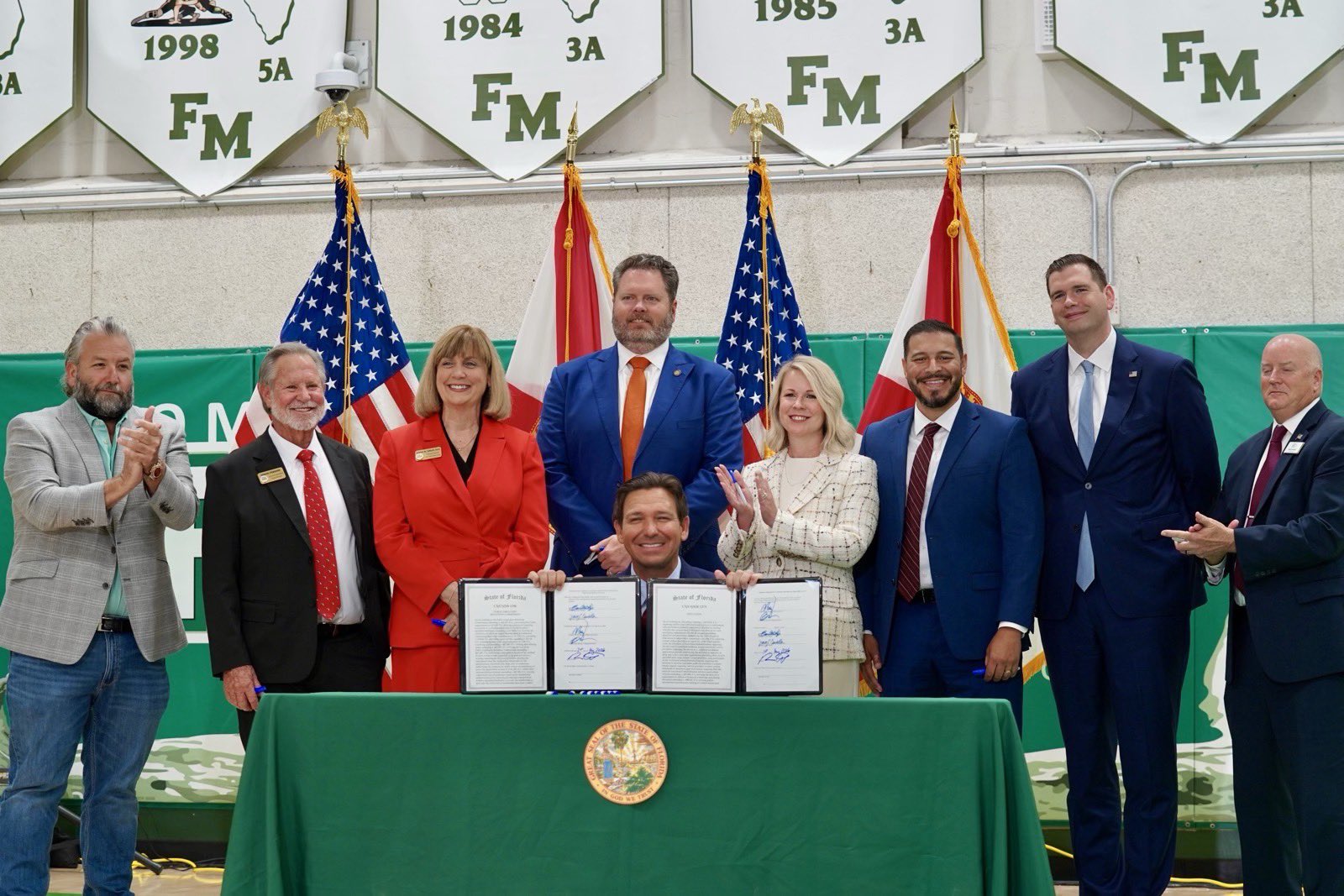
That measure (SB 1296), sponsored by Fort Myers Republican Sen. Jonathan Martin, updates the law to require at least 50% of a public employees’ bargaining unit to vote in certification, recertification and decertification elections. And if less than 60% of employees in a bargaining unit are dues-paying union members, the union must petition the state for recertification.
As was the case with SB 256, the strictures in SB 1296, effective July 1, don’t apply to public safety employees like police and firefighters.
When he signed the measure last month, DeSantis touted its changes as targeting “partisan teacher unions” whose work doesn’t reflect general will of educators.
“You should not have these entities operating if they do not have support from the people they purport to serve,” he said before signing the measure on May 1, International Workers’ Day.
Education Commissioner Anastasios Kamoutsas, DeSantis’ former Deputy Chief of Staff, said, “Public unions hate this democracy (and) bill because they want to force employees to join, coerce dues payments from them, and provide them with no real option for reconsideration.”
The Florida Education Association, which represents approximately 120,000 members across the state, offered a different interpretation.
“Instead of making life more affordable for … public-sector workers who help make Florida safe and prosperous, the Governor and his activist administration are being clear that they do not care about the workers of this state,” the organization said, adding that under DeSantis, Florida has ranked 50th in the nation in average teacher pay for three straight years and 41st in per-student funding.
Notably, DeSantis endorsed a slate of Republican candidates for School Board in 2024 and backed more than 30 such candidates in 2022. He also signed legislation approving a ballot question to make School Board races partisan, which failed.
The Florida AFL-CIO said that despite DeSantis’ assertion about hyperpartisanship in labor organizing, more than 30% of Florida union members are Republicans, with close to another third being independent or non-party affiliated.
SB 256 used language devised by the Freedom Foundation, a Washington free-market conservative think tank, which launched a multimillion-dollar campaign to decertify United Teachers of Dade after GOP lawmakers pushed the measure to passage three years ago.
That effort failed, with 83% of the union’s members voting to recertify it and reject another entity called the Miami-Dade Education Coalition, which the Freedom Foundation supported financially.
SB 1296’s language is similar to the “Union Recertification Act” proposal by the American Legislative Exchange Council, whose members include conservative interest groups and GOP state lawmakers, including House Speaker Daniel Perez and Coral Gables Rep. Demi Busatta, the organization’s current national Chair.
Republican state legislators in Iowa forced through a similar law in 2017.
Florida AFL-CIO President Kimberly Holdridge attributed SB 1296’s passage to an organized effort by the Governor’s Office and “billionaire out-of-state think tanks,” but called it a “temporary win.”
“While wealthy special interests might believe they have the power in the halls of Florida’s Capitol, Florida’s public-sector workers have the power and support in our communities statewide to show them otherwise,” she said. “We will organize and come back stronger than ever.”
The post Despite Gov. DeSantis’ union crackdowns, AFSCME Florida keeps winning appeared first on Florida Politics – Campaigns & Elections. Lobbying & Government..